


How many names should I have in my prospecting list?
Start by taking a look at how many names you need to get one client. Consider the industry standard for sales ratios: you need to talk to 10 people to see 3 and get 1 client.
- If your goal is to acquire 50 clients, you will want to see 150 people from whom you obtain Quick Facts. For example, Quick Facts can be Financial Information about the prospect.
- That sounds like a lot of meetings; but on average you would only need to collect an average of 3 Quick Facts per week.
- To get to 150 Quick Facts, you will want 500-600 names to fill the funnel.

How do I get to 500 names?
500 names can sound like a lot. However, this is why you start by building plans to effectively approach your natural market. We will walk you through these steps in this guide. It’s the starting point to expand your network and explore opportunities for other marketing methods.
As you approach your natural market, you can ask for introductions to others who can benefit from the services you offer. People don’t know who you don’t know, so ask them for help and expand your network through the people they know. In addition, you can identify potential centers of influence. Social Media can increase awareness of your business and key messaging. Networking through a range of groups or associations are methods that can help you keep your funnel full.

What Makes a Name a Prospect?
You want to get to 500 names because having a name and contact information does not make them a prospect. To be a prospect they should fit three criteria:
• Have a need
• Have the ability to pay
• Have a demonstrated interest (i.e. Appointment set, Collected Quick Facts)
To find out who your prospects are, start by collecting and organizing your names using the Natural Market Inventory Workbook. If someone doesn’t have the ability to be a prospect at the moment, add them to your email or mailing lists to drip on them. Over time they may find a need to meet with you about their financial situation.
📄 CLICK HERE to launch the Natural Market Inventory. The spreadsheet will be automatically downloaded.
Development Phases
These steps help you evaluate your natural market and develop strategies for approaching your market. Leveraging who you know effectively from the beginning of your career can help you to achieve long term success.


Your natural market is everyone you know. Every day you touch people who may need your help or can be a potential advocate in helping you build your business. For example, every day you are meeting new people as you go about your normal activities: getting coffee, going to the gym, networking. In addition, you are talking to friends, family, children’s friend’s parents etc.
As you brainstorm, consider the people you have met in all aspects of your life.
Categories of People to Consider:
As you brainstorm the people you know, think about how you know them and what other connections they can help you make. To get started, here are some general categories within your network to consider:
- Family, friends and neighbors
- Professionals - Consider who you know or use for professional services such as Attorneys, Doctors, Mortgage Brokers, CPA’s, and Realtors etc.
- Social Networks:
- Facebook – Pull up your Facebook friends list. Who are your friends that you communicate with?
- LinkedIn – Pull up your LinkedIn profile and review your LinkedIn connections. Who can you reach out to?
- Co-workers and classmates
- Consider your former employers, colleagues, mentors and former classmates.
- Groups and associations
- Professional associations
- Alumni associations
- Personal groups
- Sports or hobbies

Action Steps
- Brainstorm people in your natural market.
- Add all names to the Natural Market Inventory Workbook.
- Brainstorm based on the categories listed or any that make sense for your situation.
- Fill in remaining information you have on each person.
To start, open your Natural Market Inventory Workbook where you will find instructions on how to populate the workbook on the first Overview tab.
As you brainstorm, input contacts you know on the Natural Market Inventory tab.
- There may be some individuals on your list that you are unsure of or who have missing information. That is okay. For the best results, make the most accurate estimate you can. It’s also a good idea to note the source of the names for future reference
- The more information you know and outline, the better you will be able to provide potential clients with suitable products and services based on their needs — and adjust your communication style as needed.
- Once each individual is listed by connection and occupation, you should complete the remaining columns to the best of your knowledge.

Summary of Market Groups
Here’s an example of some of the demographic themes you could uncover in your Natural Market Inventory:
- Contacts Over Age 50
- Contacts Under Age 50
- Households with Children
- Business Owners
- Professional Workers
To get started, open up the Summary of Market Groups tab, to view the total of people in each market group category.
You may notice that this tab is now populated based on the information provided on the Natural Market Inventory tab.

Pie Charts of Natural Market by Age, Income, Gender, Relationship
As you populate this new tab, pie charts are created on subsequent tabs to visually provide perspective on your natural market. For instance, you may find that you have more people in your natural market that are over 40, like art and philanthropy and work in the business and financial industries.
Here are a few examples of what you’ll find on your pie charts:
> The Market Group chart breakdown can help you determine major clusters of your natural market that are Business Owners, Professionals, Executives and more. By segmenting out these groups, you can have a more tailored approach.
> The Income Distribution chart breakdown can help you prioritize who to reach out to initially. For example, you may want to target the lower income earners to gain practice having conversations and then move up to their more affluent contacts later.
> The Age Breakdown chart can help you determine age appropriate solutions for your contacts.
Take note of these points and use them to carve out your target prospect market.

Natural Market Identifier Exercise
In the Natural Market Identifier Exercises tab, you can use the pie charts to quickly identify your affinity markets.
- The goal of this exercise is to identify potential markets based on your natural affinity. For example, if you have a passion for music, musicians may be a potential market for you to target.
- Knowing this information will help you tailor your marketing strategy. For instance, with musicians it’s recommended you lead with communications that feature articles or topics related to music and the arts.
- By speaking their language and highlighting topics they may be concerned about, you can increase your chance of setting an appointment with them.

Determine First Targeted Group
Once you have determined your key demographic areas, it’s time to determine your first group of contacts to approach. For new Financial Representatives, we recommend you build your approach list based on the bottom ranked names first rather than the best names. This is to help you build your skills on appointment setting and your open talk with potentially your least intimidating prospects.
We recommend you work with your Market Leader to break down your list and evaluate the best opportunities for you to approach first.


📄 FR Business and Marketing Plan Template
Complete this Business and Marketing Plan Template to help:
- Define Your Vision and Goals
- Identify Market Groups and Assess Opportunity
- Define Your Ideal Client
- Action Plans
- Create Your Model Work Week
ACTION: 📄 Download and Complete the Fillable PDF.

✏️FR Guide: Your Natural Market
As you begin to build your marketing plan, the first step is to take a look at your natural market. Your natural market is everyone you know. Every day you touch people who may need your help or can be a potential advocate in helping you build your business. Enroll in this class to begin this extremely useful process.
ACTION: ✏️ Take this Course

📄 Market Opinion Survey
Use this survey to contact members of your Natural Market to learn about business opportunities with people in their profession or industry. The interviews may be done in person or over the phone. Share results of the interviews with your Agency Leader to help identify potential target markets.
ACTION: 📄 Download and complete.

Grow Your LinkedIn Network-25x4 Strategy
Start growing your LinkedIn network using this systematic process that allows you to connect with prospects you’re interested in working with.
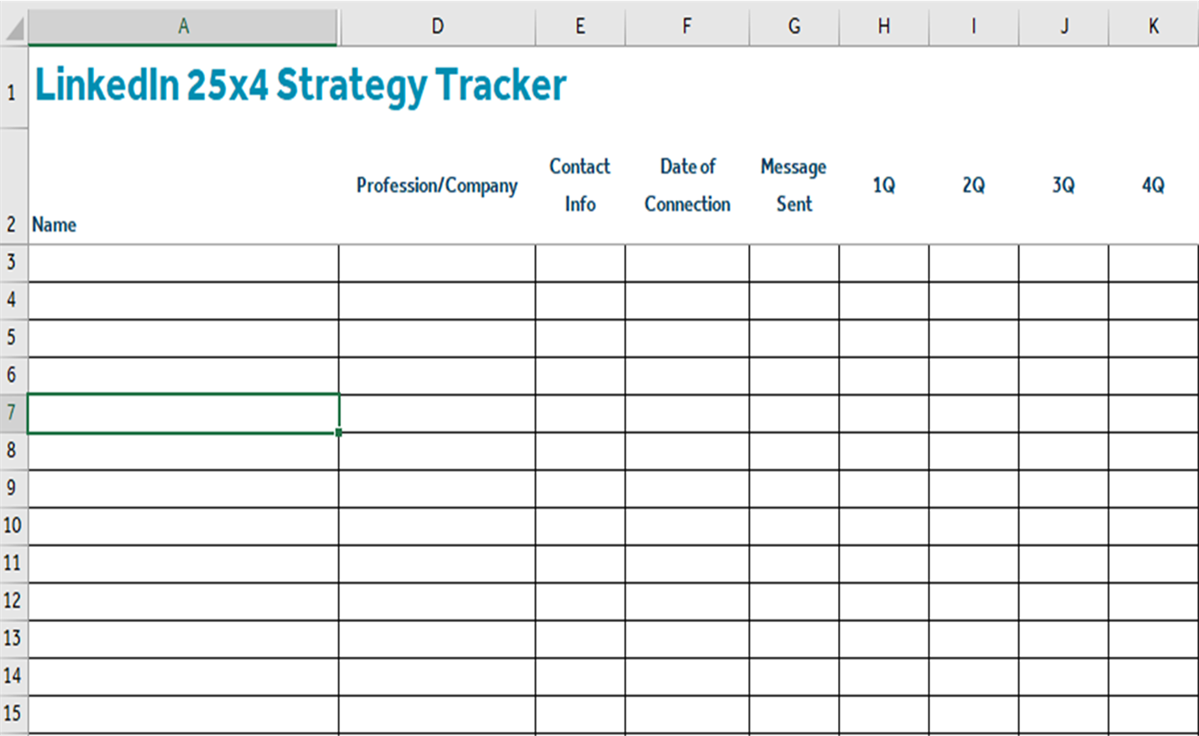
Step 1: Create a tracker- This will allow you to keep score and stay organized. CLICK HERE to Download a 25x4 Strategy Tracker.


The ABCs to LinkedIn: Your Connections from A to Z.
How many of your connections do you really know? In order to best utilize LinkedIn as a tool to help you grow your business, you should only be connected with people who you would feel comfortable sharing your Why with, working with and/or leveraging for introductions.
Working your way one letter at a time, one week at a time, start going through your existing connections. For each name you come across, you could:
A. Reconnect with someone you haven’t talked to in a while
B. Start a conversation with those who you don’t know and would like to know
C. Delete those who you do not want to start a conversation with, nor would want to ask for an introduction

Find Ideal Connections- Who to Invite?
It’s easy to strike up a conversation with an ideal prospect based on commonalities. Attendance at the same educational institution, service in the same branch of the military, prior employers, location of upbringing, a common culture, language, or interests, are all easy conversation starters. LinkedIn’s advanced search capabilities enable us to quickly identify hundreds or thousands ideal prospects with whom we have several meaningful experiences in common.
- Connection Level- For the purpose of identifying ideal prospects, searching for 2nd level connections is most effective. Whenever feasible, filter for individuals who are connected to at least one of your 1st level connections.
- School- Many institutions of higher or otherwise specialized education deliberately encourage the maintenance (or formation) of strong mutually supportive bonds among their alumni. Financial advisors always benefit from making sure appropriate alumni of their own educational institution(s) connect with them.
- Title- Searching for business owners, CEOs, CFOs, presidents, and vice presidents typically identifies hundreds or thousands of ideal prospects in one or more states in which you are licensed. Other effective filters can be built based on professional titles, such as architects, dentists, designers, engineers, lawyers, etc.
- Industry- An industry that facilitates business ownership are ideal. Car dealers, construction companies, franchise owners, law firms, manufacturers, health care, real estate, and the hospitality industry are high value targets.
- Current or Past Company- If you are a career changer, pursing prospects in your prior industry will produce impressive results. Even if you are not a career changer, target industries that facilitate the formation of small and medium sized businesses.
- Connections Of (COIs)- You can build filters to identify appropriate individuals from among your existing connections. Let’s say you are connected with an influencer at a company, association, or industry. Look at their connections. Which subset of those would likely benefit from getting to know you? Existing connections help in another way. If you reach out to a prospect who is already connected to you, your prospect might reach out to your existing connection to inquire about you and what you do. Asking for and receiving introductions is one of the most effective ways to grow your business.
- Profile Language- If you speak a foreign language, you can differentiate yourself by reaching out to prospects in their native language.
- Non-Profit Interests- LinkedIn allows you to filter for individuals who provide skilled volunteer services or agree to serve on corporate boards.
- Schools- You can specify additional schools of interest. For example, if you went to two rival schools, you could filter for others with the same experiences, and maybe capture the attention of others who attended both schools, perhaps before a big rivalry sporting event.
- Location- While it is relatively easy to get non-residence licenses in states in which you are not currently licensed, build your initial filters based on the states in which you are already authorized to do business.